
Types of root
Roots hold the plant in the ground and allow it to take up water and nutrients. They can also be used to store food. There are 3 types of root in the exam.
Apologies for the poor pictures – I’m not so good on the drawing programmes. But I hope you get the idea and will be able to reproduce something along these lines if necessary in the exam.
- Tap root – formed from the radicle of a seed, this is a main root with branches off it and can be quite deep.
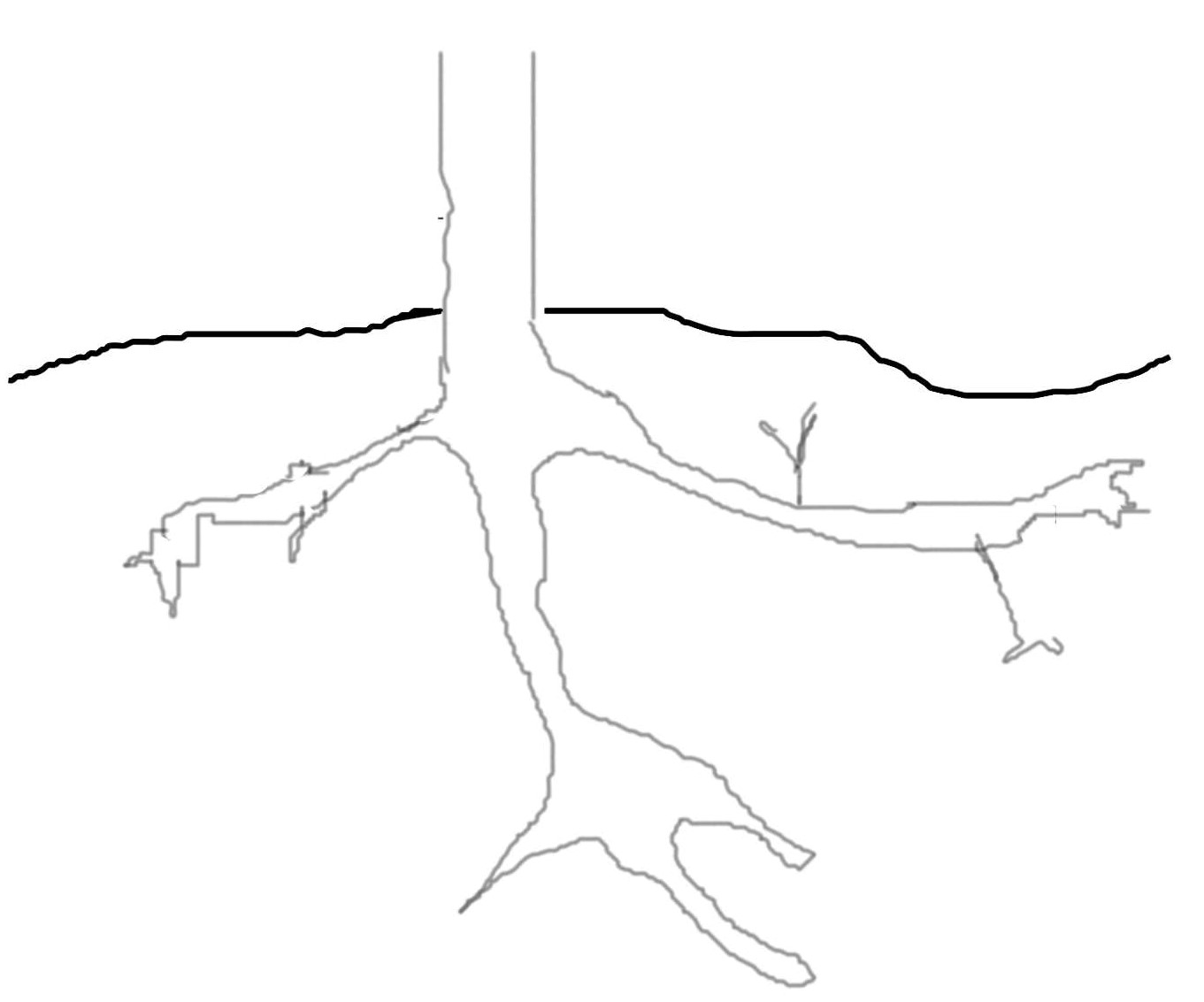

- Fibrous roots. These have no main root and just branch off from the base of the stem. These are shallow roots and typical of monocotyledons.
- Adventitious roots – these grow from other parts of the plant, such as the runners of strawberries.

Root cross-section diagrams

This is a diagram of the cross-section of a dicotyledon root – it does not seem that they will ask you about monocotyledons. This question has come up several times, so probably best to learn to draw this diagram and to be able to label it.
In terms of what the areas of the root do:
The cortex produces the energy to grow the root. The endodermis controls the movement of water from the cortex to the xylem [see the movement of water later]. The pericycle is band of cells from which new roots grow, passing through the cortex.
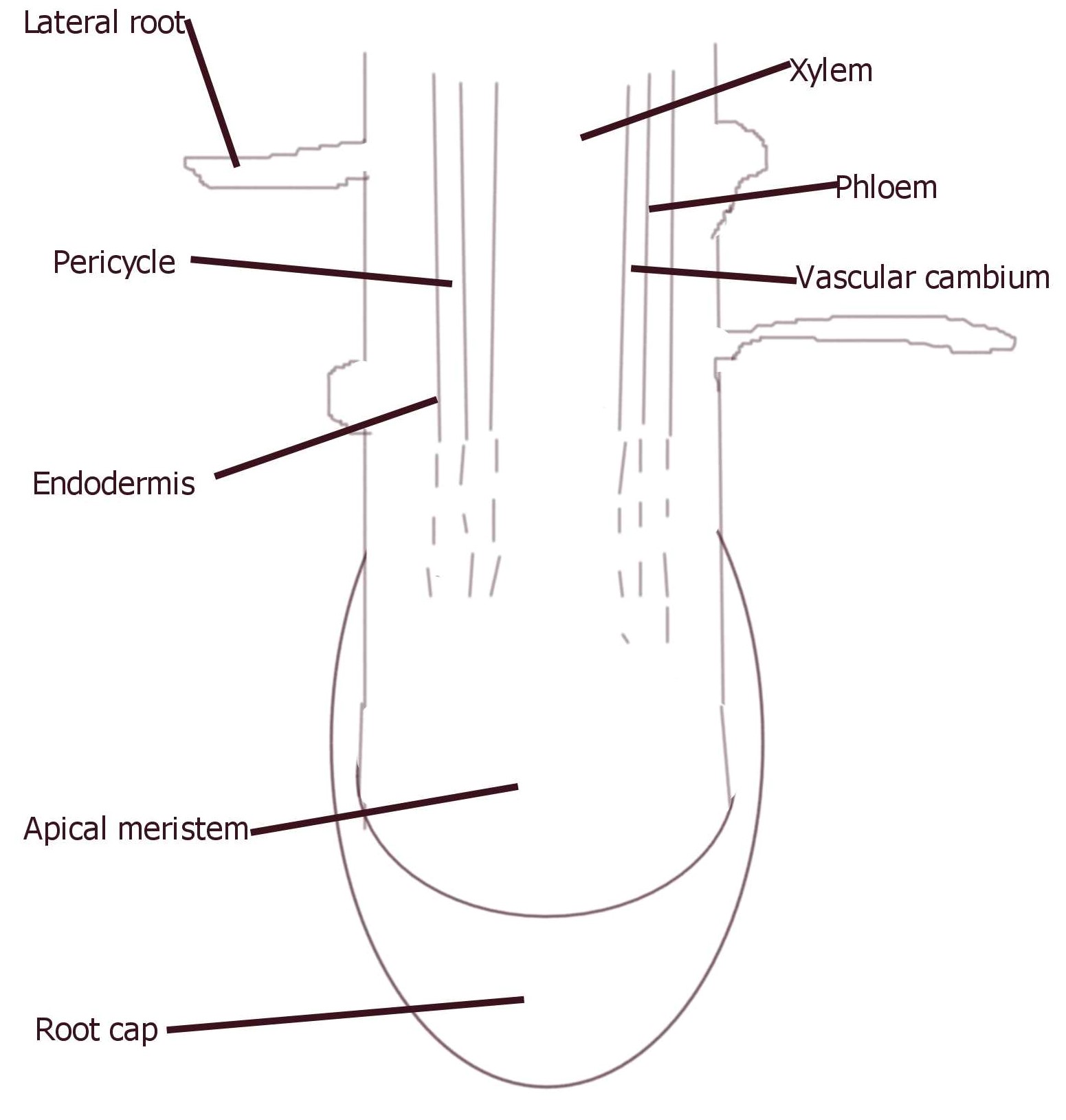
The diagram above is an attempt to show a length-wise cross-section of a root. I don’t think that this appeared in any of the past papers, but that could just mean that it is due soon! The area from the top to the endodermis label is the Zone of Cell Differentiation, as the cells have become part of particular tissues or specialised. The area with the dotted lines is the Zone of Cell Elongation. The area at the end where the Apical Meristem label is pointing is the Zone of Cell Division, where the cells actually divide and the root grows. The root cap is a protective layer to protect the growing root tip.
Cell expansion is caused by water pressure in the cell. This pushes outwards when the cell is young and stretchy. This happens in the zone of elongation. Once a cell has differentiated it cannot really expand further so it is important that plants are well watered whilst growing.
Root adaptations
- Perennation = this is just starch storage. Some plants are able to store food in the root to survive unfavourable conditions, eg: bulbs, corms, tubers. Examples are Daucus carota (carrot) which has a swollen tap root.
- Climbing = adventitious climbing roots develop along the stem attaching to other plants or walls. Example: Hedera helix (ivy) has aerial roots to allow it to climb. The plant gets water and nutrients from its own roots so it is not parasitic, it just climbs using the adventitious roots.
- Support/prop roots = roots at the base of the stem for support. Example: Zea mays (sweetcorn)

 Gardening studies
[…] Roots – R2101 – Roots […]
LikeLike
[…] Root: xylem, phloem, cambium, epidermis, endodermis. R2101 – Roots […]
LikeLike