

I know that’s a really bad drawing – I hope you get the idea anyway. Labelling the parts of the leaf blade has come up before.
Leaf adaptations
- Storage/perennation – bulbs are a lot of leaves containing food eg: Narcissus.
- Water storage – succulent plants store water in the leaves eg: Sedum.
- Protection – spines on the leaves eg: Berberis.
- Climbing – using tendrils growing from the leaf eg: Lathyrus odoratus or by petioles curling around another plant eg: Clematis.
- Bracts – are flower replacements to attract pollinators eg: Hydrangea.
Leaf cross-section
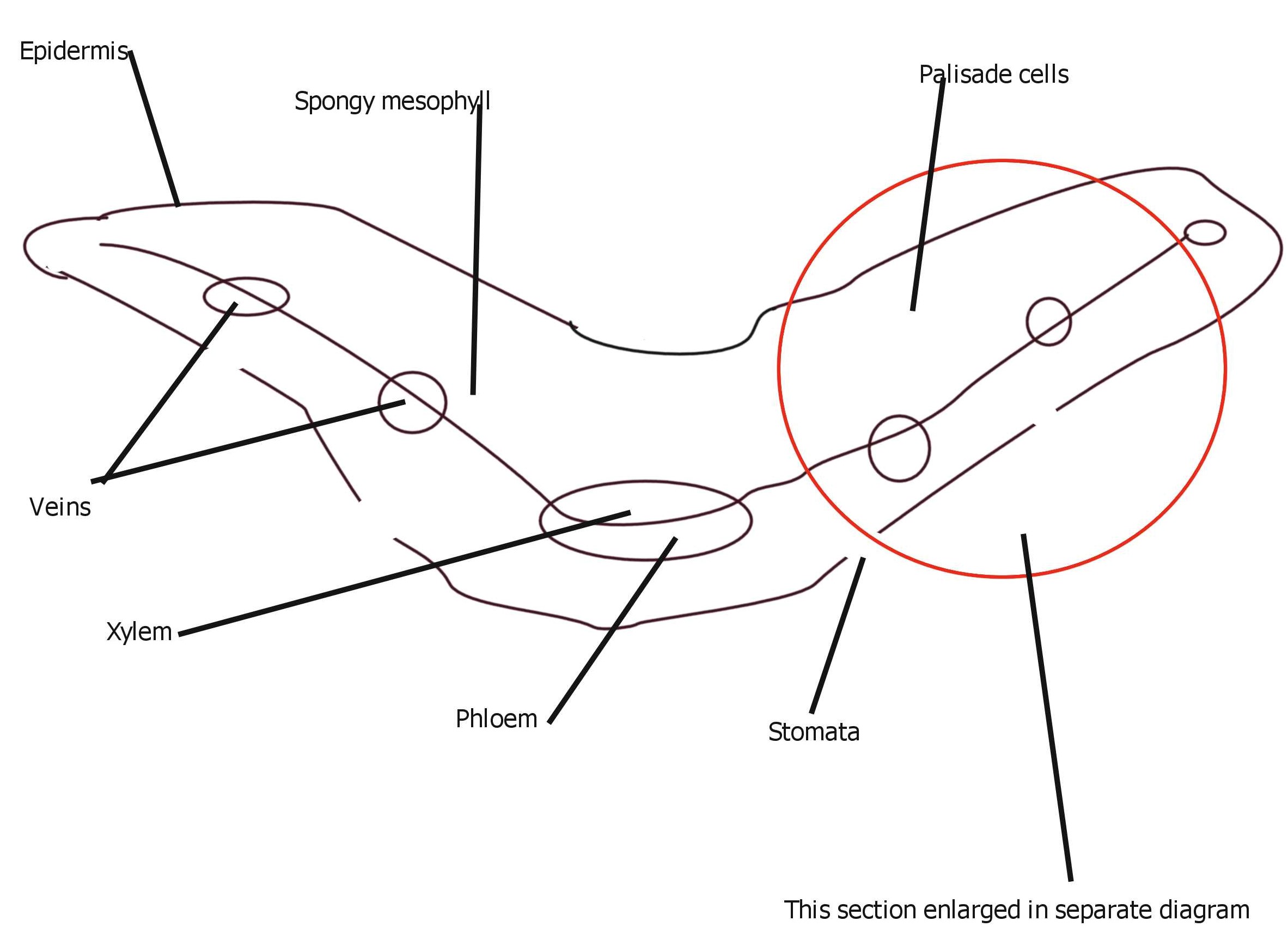

A question asking for a drawing of a leaf cross-section has come up before. The model answers did not show the drawing the examiners wanted, but did list out the parts they wanted labelled. I have not been able to find anywhere a diagram showing all of the parts they wanted so have given 2 diagrams above which have all the parts they wanted. If you could draw well enough, you could probably show both in one diagram but I thought it would be clearer as two.
You can see that the leaf is made up of layers including:
- Cuticle – which is a waxy layer on top of the epidermis.
- Epidermis – which is generally only one layer thick and transparent so that light can pass through.
- Palisade layer – which is a layer of lots of cells packed together as close as possible with as many as possible in the space. These are for photosynthesis and have lots of chloroplasts.
- Spongy mesophyll – are a packing layer really, with lots of air spaces for gas exchange.
- Cuticle on the lower side of dicotyledons have stomata. These are openings for gas exchange. These openings can be closed by the guard cells on either side which can swell with water to open or close the opening.
 Gardening studies
[…] Leaves – R2101 – leaves […]
LikeLike
[…] Leaf: xylem, phloem, epidermis, lamina, stomata, palisade, spongy mesophyll. R2101 – leaves […]
LikeLike