
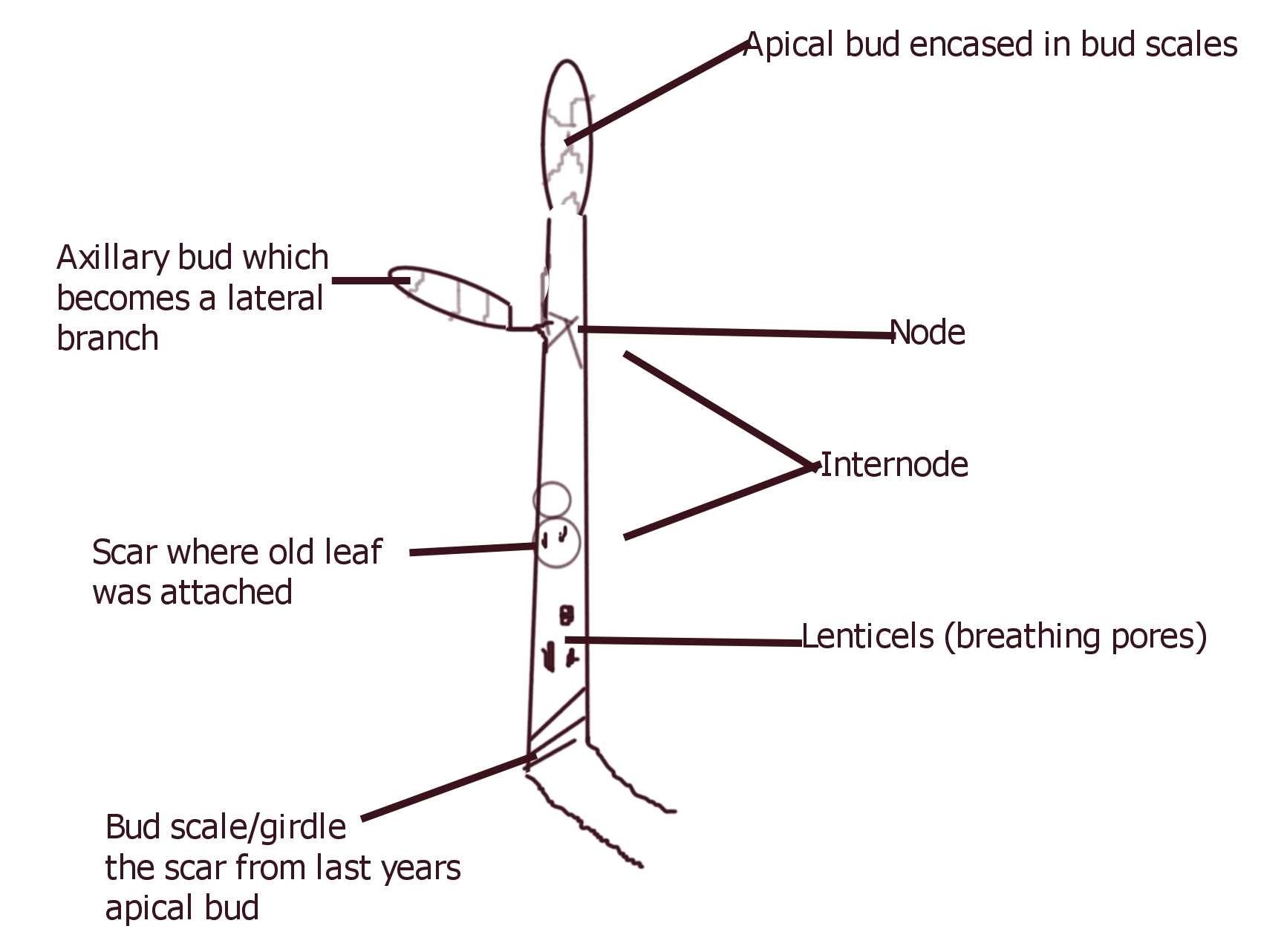
Ok, so apparently you will need to be able to draw/label a diagram like the one above. I don’t think this question has come up in the last couple of years but you never know. You will also need to know the cross section of a dicotyledon stem drawn previously which seems much more likely to come up in an exam.
Stem adaptations
- Protection – thorns are modified branches growing from axillary buds so they have a vascular connection. Example: Cratageus monogyna (hawthorn). Plants can also have prickles which are just outgrowths of the epidermis . Example: Rosa.
- Storage/perennnation – these can be corms, stem tubers or rhizomes. Corms are compressed, swollen stems storing starch eg: Crocus. Stem tubers are starch tuber with axillary buds and the ability to photosynthesize, eg: potato. Rhizomes are underground, horizontal stems with nodes and internodes from which shoots form, eg: Iris germanica.
- Climbing – stems can twine around other plants or structures to climb. Example: Wisteria floribunda.

- vegetative reproduction – runners can be formed by horizontal stems running along the ground and rooting at nodes eg: Fragaria. Vegetative reproduction also occurs through rhizomes and stem tubers, as listed above for perennation.
 Gardening studies
Really clear and helpful – thank you,
LikeLike
[…] Stems – R2101 – stems […]
LikeLike
[…] xylem, pholem, cambium, epidermis. R2101 – stems but you don’t need the adaptations here. R2101 – Plant Classification, structure […]
LikeLike